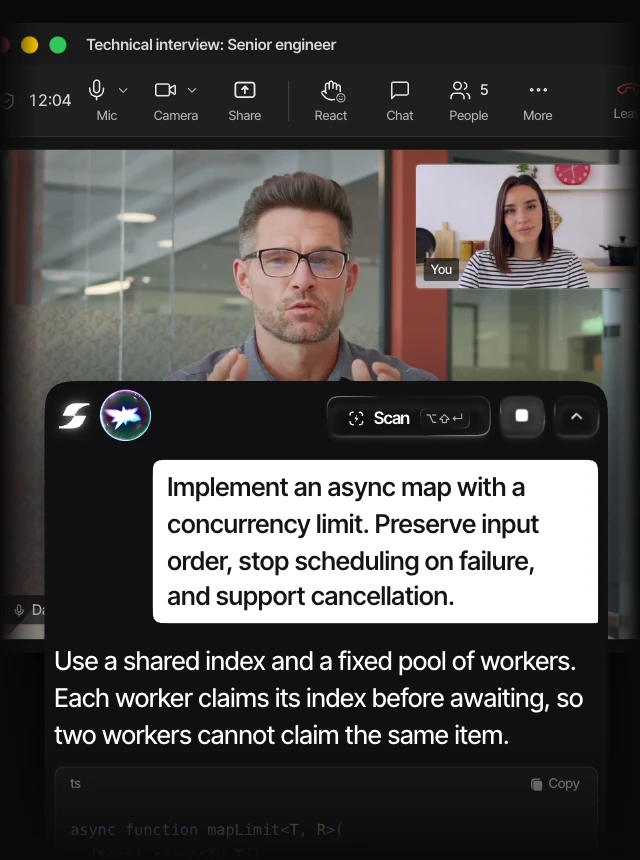
Use a shared index and a fixed pool of workers. Each worker claims its index before awaiting, so two workers cannot claim the same item.
ts
asyncfunction mapLimit<T,R>(
items:readonlyT[],
limit: number,
run:(item:T, signal?:AbortSignal)=>Promise<R>,
signal?:AbortSignal,):Promise<R[]>{if(!Number.isInteger(limit)|| limit <1)thrownewRangeError('limit must be a positive integer');
signal?.throwIfAborted();const results =newArray<R>(items.length);let next =0;let failed =false;asyncfunctionworker(){while(!failed){
signal?.throwIfAborted();const i = next++;if(i >= items.length)return;try{
results[i]=awaitrun(items[i], signal);}catch(error){
failed =true;throw error;}}}awaitPromise.all(Array.from({ length:Math.min(limit, items.length)}, worker,));return results;}
Why it works: results are written by input index, not completion order. At most limit calls are in flight. A rejection stops new work; already-running tasks finish unless their implementation honours the abort signal.
Edge cases: empty input, a limit larger than the input, out-of-order completion, a rejected task, and cancellation before or during the call. Time is O(n) bookkeeping plus the async work; result storage is O(n).
Arriva pronto al secondo colloquio.
Conserva domande, risposte e ciò che devi preparare.
Esempio 1 di 3
Conserva le decisioni. Ricorda i tuoi impegni.
Sayli
Meetings
N
From earlier today
Technical interview: Senior engineer
Thursday, November 5 · 10:00 AM · 32 min
With You, Daniel Novak
A worker pool, with ordering, failure and cancellation covered.
Daniel asked for an async map with a concurrency limit. You discussed keeping results in input order, stopping new work on failure and passing cancellation to each operation.
Technical interview: Senior engineer. Daniel asked for an async map with a concurrency limit. You discussed keeping results in input order, stopping new work on failure and passing cancellation to each operation. Next steps: Practise the failure and cancellation walkthrough, You, Thu. Prepare tests for out-of-order results, You, Thu.
Chiamata di esempio · Technical interview: Senior engineer

 Daniel Novak